

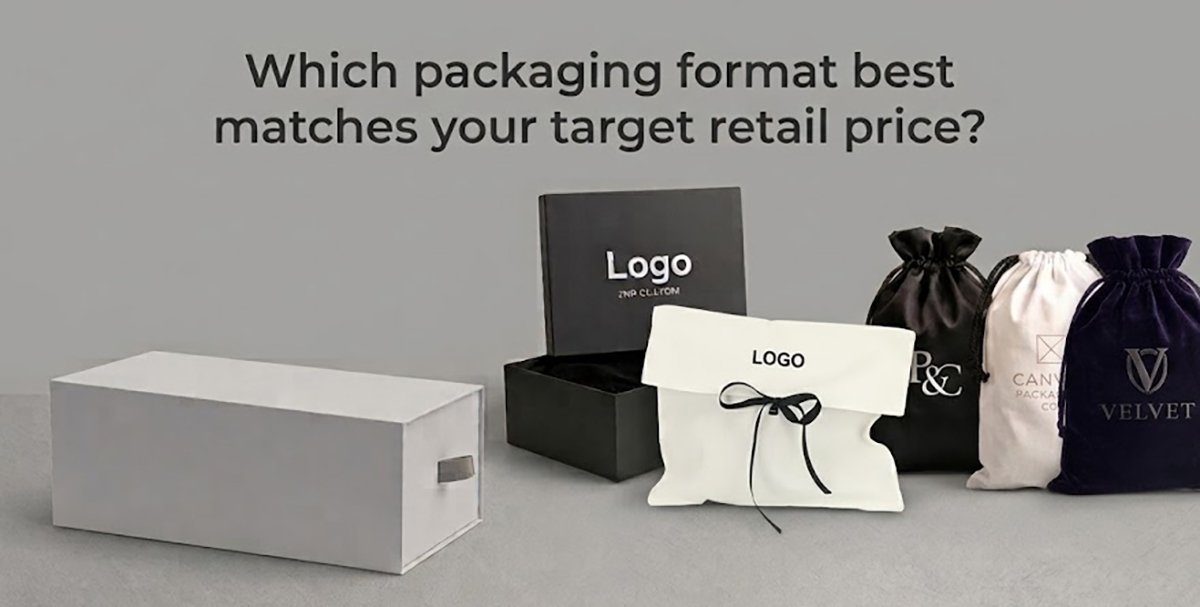
For a mid-range slipper, the wrong packaging choice can quietly add more to your landed cost than the product itself. At Yangzhou JNP, we help overseas brands compare the full cost of each option — not just the per-piece price — so the packaging supports the margin instead of eating it.
The question is not which package looks more premium. It is: "Which packaging format matches my target retail price, and how does it change my true landed cost?"
The Real Job of Packaging: A "Worthy" Feeling
The job of packaging is to make the end customer feel the product was worth the price the moment they open it.
Protection during transit is the baseline. The real work is emotional: a premium slipper needs to feel expensive from the first touch. A cheap, unbranded polybag can destroy perceived value before the customer tries the footwear on.
For B2B buyers, packaging is the first physical touchpoint of the brand. It bridges digital marketing and the physical product. A quality fabric bag does this without the volume penalty of a rigid box. In our experience, for mid-range indoor slippers, a well-made cloth bag already separates the product from supermarket polybag styles and signals a considered purchase.
The Hidden Cost Trap: Packaging Can Cost More Than the Product
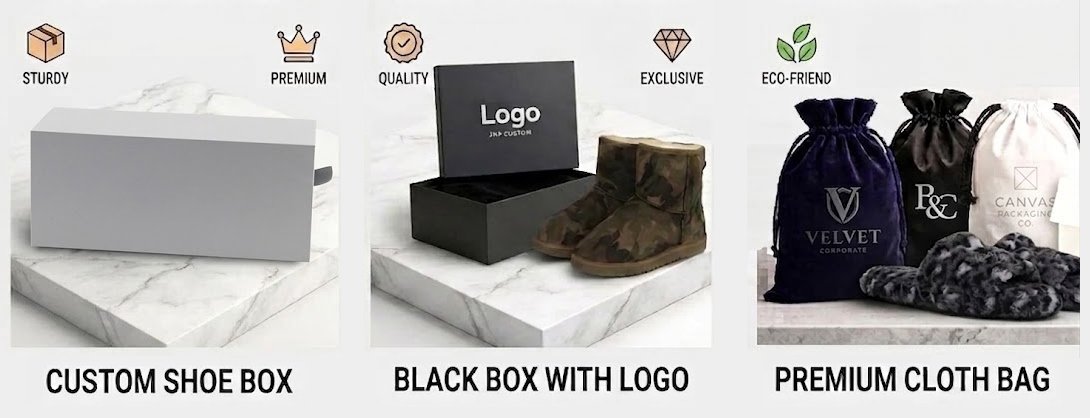
For low-volume orders, a custom shoe box can cost more per unit than the slipper itself.
Here is how the math changes when your order volume does not match the packaging MOQ. If you order 100 pairs of slippers but the custom box MOQ is 1,000 pieces, the 0.80 box base price amortizes to 8.00 per pair. You are paying for 900 boxes you cannot use.
On top of that, shoe boxes take up roughly two to four times more chargeable volume than flat-packed cloth bags, depending on the style. That difference affects freight more than most buyers expect on lightweight footwear. Airlines and couriers calculate this using dimensional weight rules1, which is why rigid boxes hurt shipping costs even when the product inside is light. The result: packaging-related costs can more than double your landed cost before the product reaches the warehouse.
| Packaging Option | Unit Base Cost (Approx.) | MOQ Requirement | Shipping Volume Factor | Ideal Retail Price Tier |
|---|---|---|---|---|
| Custom Shoe Box | $0.80 | 1,000 pcs | High (2x–4x larger volume) | Premium ($100+) |
| Black Box with Printed Logo | $2.00 | 100 pcs | High (2x–4x larger volume) | Mid-to-High (60–100) |
| Premium Cloth Bag | 1.20–2.00 | 100 pcs | Low (highly compressible) | Mid-Range (30–60) |
Note: Cloth bags typically require an initial plate/setup fee of 50 to 100, bringing the first small-run actual unit cost to roughly 2.00 to 3.00. This is still far below the amortized cost of an unused custom-box MOQ.
Three Packaging Formats for Three Price Tiers
The right packaging tier depends on your end selling price and channel, not on how premium the box looks in a catalog.
Custom Shoe Boxes: For Premium $100+ Products
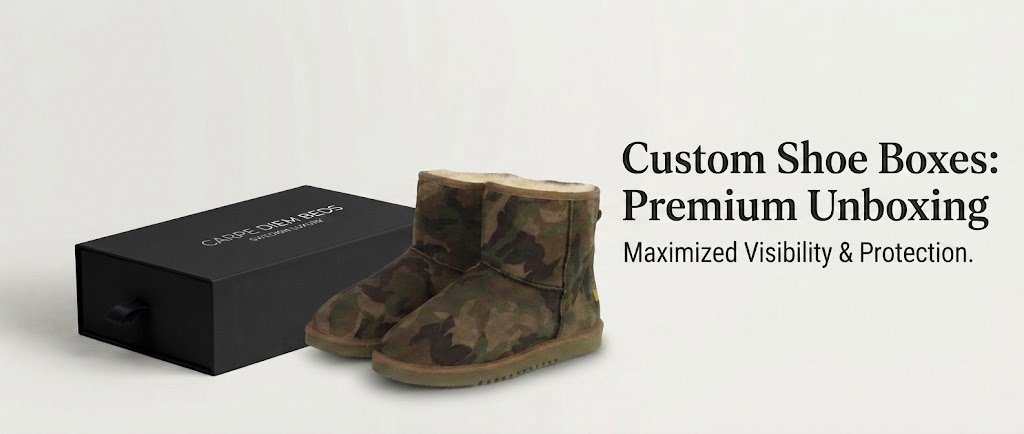
Custom shoe boxes work best for high-end designer brands where the customer expects a full luxury unboxing experience. These boxes provide maximum physical protection for delicate styles, such as sheepskin boot slippers, and they justify their higher volume cost when the retail price leaves enough margin to absorb it.
Black Boxes with Printed Logos: The Compromise for Mid-to-High Tiers
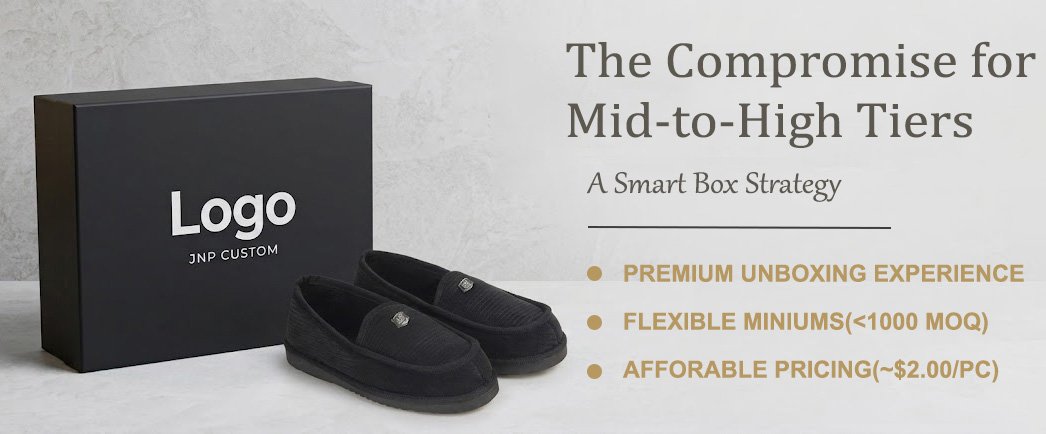
A simple black shoe box with a custom-printed logo offers the structure and unboxing feel of a box without the 1,000-piece custom MOQ. At roughly $2.00 per piece, it lets online brands test the market with smaller initial orders while still looking like a finished retail product.
Premium Cloth Bags: The Flexible Choice for Growing Brands
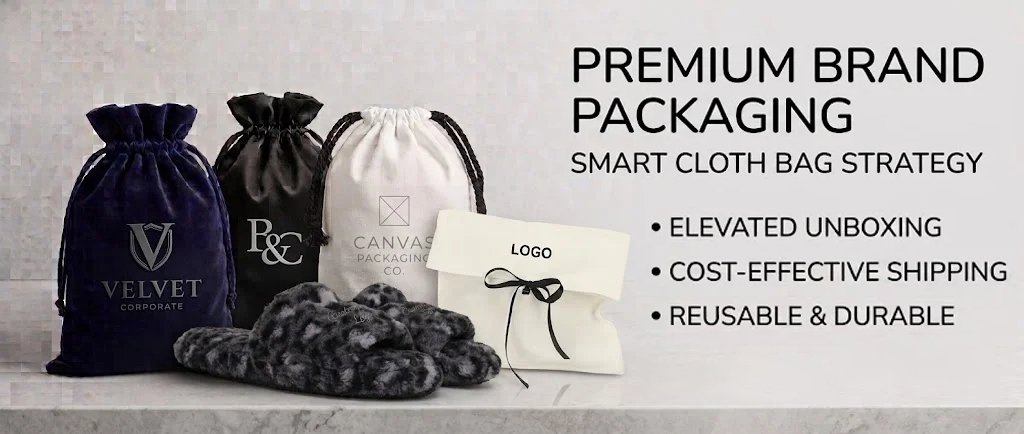
Premium cloth drawstring bags — canvas, linen, or satin — deliver a "dust bag" feel without the manufacturing and shipping overhead of a box. They are compressible, keep container volume compact, and often feel reusable to the end customer. For mid-range slipper brands, this is usually the most cost-efficient way to signal quality. Industry packaging cost guides, such as custom packaging cost2, show similar patterns: rigid boxes carry the highest per-unit and shipping premiums, while soft packaging scales better for smaller volumes.
How to Choose Without Overcommitting
Start with the lowest-cost option that still delivers the perceived value your customer expects.
We recommend this sequence:
- Set your end selling price first. Packaging is a function of margin, not a standalone decision.
- Calculate true landed cost. Include unit price, setup fee, MOQ amortization, and the volume-based freight difference between box and bag.
- Test the cloth bag first. At 100 pcs MOQ, it is the cheapest way to validate whether your customers care about packaging.
- Upgrade only when data justifies it. If customers respond and your price point supports it, move to a black box or custom shoe box on the next reorder.
The mistake is locking into a 1,000-piece custom box MOQ before you know whether your end customer will pay for it.
Conclusion
Packaging is a signal, not a cost center. The right choice tells the customer what price bracket the product belongs to before they try it on. For most mid-range indoor slippers, a quality cloth bag sends the right signal without destroying the margin. Match the tier to your retail price, test it at low volume, and scale the packaging only after the product has proven itself.
At Yangzhou JNP, we offer cloth bags, black boxes, and custom shoe boxes, and we quote each option with the MOQ and landed cost difference clearly laid out. With 15 years in footwear supply-chain management, we help brands pick the signal that fits their business.
Ready to calculate the landed cost of your next slipper project? Contact Amanda at amanda@jnpfootwear.com or WhatsApp +86 136 2159 9262.
Footnotes
Readers can verify how air cargo dimensional weight is calculated and understand why bulky packaging can increase freight costs even when the slippers themselves are lightweight. ↩
This resource helps readers understand how packaging type, production quantity, setup costs, and MOQs affect the actual per-unit cost of custom packaging. ↩