Why can a slipper factory with the right audit reports, an acceptable MOQ and relevant production experience still make your first development feel slow and difficult?
The problem may not be production ability. Replies may arrive late, each next step may depend on another technical specification your team does not yet know how to prepare, and the factory may ask questions without helping you understand which decisions are actually needed.
Production qualification and product-development support are not the same capability. A factory may be excellent at executing confirmed specifications, yet be the wrong partner for a lifestyle brand that only has a customer profile, price position and reference image.
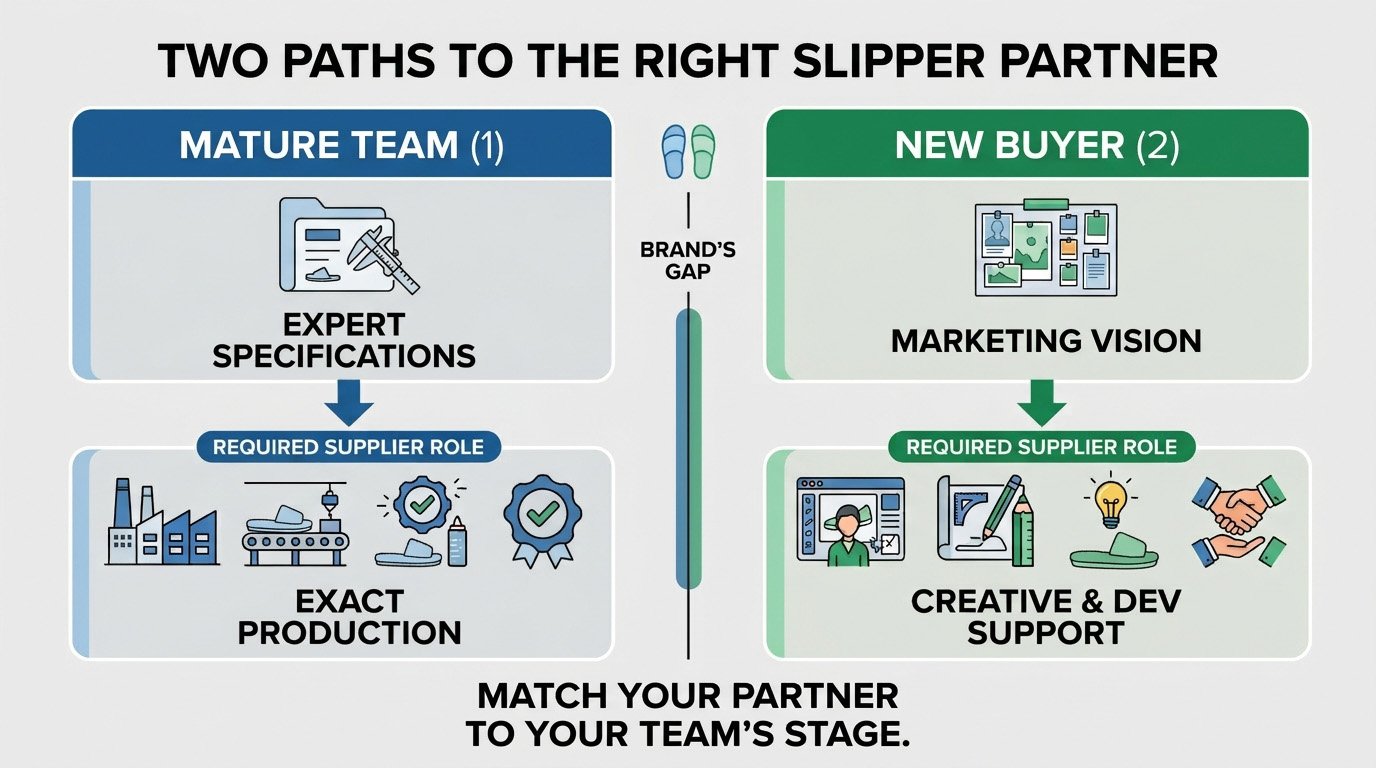
The right slipper manufacturer is the one whose role matches the brand's development gap. A mature footwear team may need precise execution; a first-time footwear buyer may need a partner that can turn a commercial idea into a product that can actually be sampled and produced.
Before contacting suppliers, the brand should first decide which type of slipper it wants to develop1. Supplier selection becomes clearer once the product's role and launch objective are defined.
Start With What Your Team Cannot Do Internally
The first question is not “Are you a factory?” but “Which part of footwear development do we need you to manage?” The answer changes the type of supplier the brand should choose.
| Your internal position | What you need from the supplier |
|---|---|
| Complete tech pack, confirmed construction and footwear experience | Engineering execution, costing, quality control and reliable delivery |
| Brand direction, customer profile and reference images, but no footwear team | Product translation, suitable base structures, material and sole options, sampling guidance and production management |
An execution-focused factory can be an excellent partner for the first situation. It may be the wrong partner for the second if it expects every measurement, component and construction decision to be confirmed before development begins.
JNP works as a footwear sourcing and production partner rather than one factory claiming to make every type of slipper. Our eight partner factories have different production strengths, and the longest relationship has lasted 16 years. The value is not the number alone; it is knowing which production line matches the product and who will manage the complete result.
Factory Qualifications Are One Part of Supplier Fit
Factory qualifications may be essential for channel access and responsible sourcing, but they should be evaluated alongside product-development support. A buyer may need both; the two checks simply answer different questions.
For example, Sedex states that SMETA is a social-audit methodology covering labour, health and safety, environmental performance and business ethics. Sedex also makes clear that SMETA is not a certification or a pass-or-fail test2. That information can support responsible-sourcing requirements, but it does not evaluate the supplier's ability to choose a last, translate a reference image or maintain sample-to-production consistency.
At JNP, we can match a project with a factory that has the audit report a customer's channel requires. We evaluate product fit separately: similar constructions already produced, materials handled repeatedly, sole experience, sampling communication and the factory's ability to reproduce the approved standard.
Should You Modify a Proven Slipper or Develop a New One?
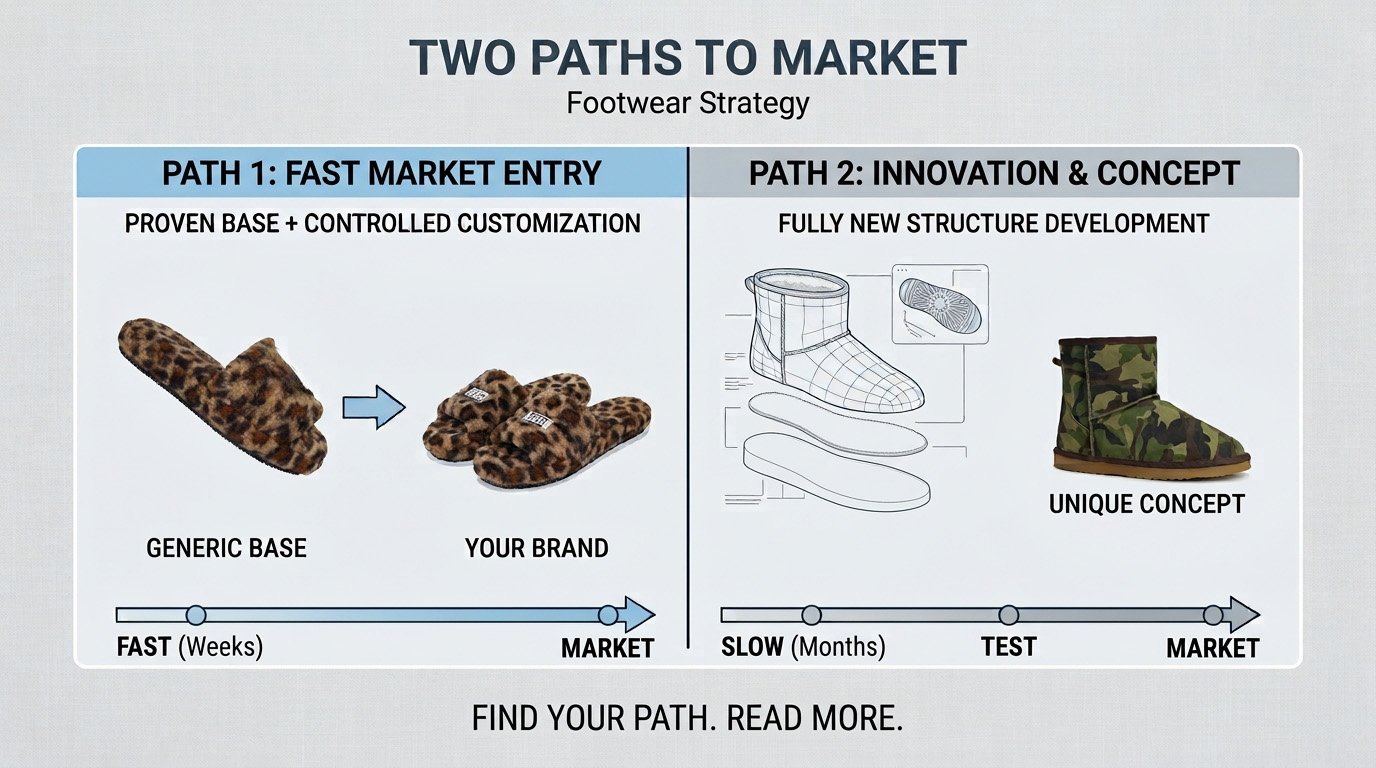
For a small first order, modifying a production-proven base is often the more controllable route—but it is not the only valid route. The decision should depend on the strength of the product idea and the evidence behind it.
A mature base is more than a showroom sample. Ideally, its last, pattern and sole structure have already been used in bulk production, corrected through customer feedback and repeated with stable results. The brand can then concentrate its first-round differentiation on colour, upper material, embroidery, trims and packaging.
This path is especially useful when the brand has no footwear team and wants to reach the market with fewer unknowns. At JNP, trend products with a custom logo can start from 100 pairs when they use an appropriate existing structure. A fully independent development normally requires a higher quantity because new patterns, tooling, materials or construction create different production conditions.
This is the same principle behind our low-MOQ custom footwear approach3: preserve the brand elements that matter most, while keeping the first test structurally manageable.
When Do Market Signals Justify New Development?
New development becomes more reasonable when several independent signals point to the same demand—not simply because one famous brand has launched one style. JNP looks for a combination of directional and commercial evidence.
Useful signals include:
- leading fashion brands introducing a related silhouette or material direction;
2) several unrelated buyers asking about similar products;
-
repeated B2B marketplace interest in the same construction;
-
the direction appearing across brands, retailers and public customer discussions.
These signals do not prove unit sales. They show that development is no longer based on one isolated idea and that timing may have commercial value. In that situation, a brand may reasonably accept more sampling work to enter the direction while it is still developing.
Trend research is not permission to copy. WIPO explains that industrial-design protection can cover a product's ornamental appearance, including its shape, patterns, lines or colour4. A supplier should translate the market need—such as warmth, an open back or a softer silhouette—without reproducing protected logos or distinctive design details.
Five Questions to Ask Before Choosing a Slipper Supplier
The best supplier questions reveal how the project will move from an idea to repeatable production. They should reduce decisions for the buyer, not create a technical questionnaire the buyer cannot answer.
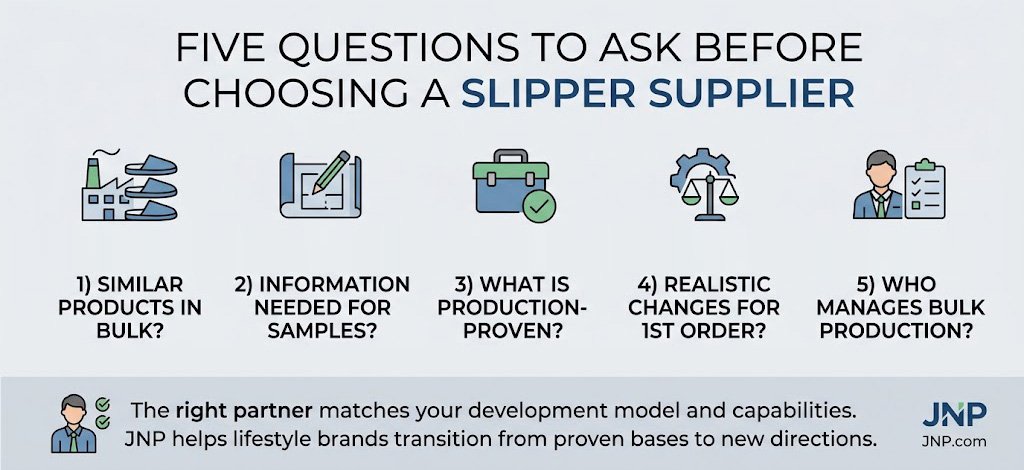
- Which similar products have you already produced in bulk? Ask about structure, material and use case, not customer names.
2) What information do you need from us before making the first sample? A development partner should be able to start from the customer, channel, season, price position and reference direction.
3) Which parts of this product are already production-proven? Confirm whether the last, pattern, sole and construction have been used before.
-
Which changes are realistic for the first order? Separate controllable brand elements from changes that require new tooling, higher material minimums or more development.
-
Who manages the approved sample through bulk production? The buyer should know who records changes, confirms materials and checks that production follows the approved standard.
The right slipper supplier is therefore not always the largest factory or the partner offering the most original proposal. It is the supplier whose development model matches the brand's current capability, evidence and launch objective. JNP helps lifestyle brands choose between a proven base and a new direction, then coordinates the production resources needed to turn that choice into a controlled first launch.
Footnotes
This resource helps brands define the type and role of slipper they want to develop before approaching suppliers, making supplier selection more aligned with the product and launch objective. ↩
This resource explains what SMETA covers and clarifies that SMETA is an audit methodology rather than a certification or pass-or-fail standard, helping buyers understand what an audit report can and cannot tell them about a supplier. ↩
This resource explains how brands can use low-MOQ custom footwear development to test important brand elements while keeping the first production project structurally manageable. ↩
This resource explains what industrial-design protection can cover, helping brands understand why trend research should be translated into an original product rather than copying protected visual details. ↩